There are several magnificent and very old temples within the walled old city of Chiang Mai, with the Wat Phra Singh being one of the most attractive.
The temple, which is also known as “The Monastery of the Lion Buddha” or “The temple of the Lion Buddha” is an active temple, with hundreds of monks and novices living there. The Wat Phra Singh houses a number of highly revered and very old Buddha images.
The Wat Phra Singh dates back to the 14th century when Chiang Mai was the capital of the Lanna Kingdom, and is one of the finest examples of classic Lanna style temple architecture in Northern Thailand.
The structures of the Wat Phra Singh
The temple grounds contain a number of classic Lanna style buildings.
Main Chedi
The oldest structure of the wat is the main chedi, that was built in 1345 by King Pha Yu to enshrine the ashes of his father. The chedi is circular in shape with a square base. Each of the sides of the chedi is decorated with elephant figures emerging from the chedi. Since its construction in the 14th century it has been enlarged considerably.
Viharn Lai Kham and chedi
Viharn Lai Kham
One of the best examples of Lanna style architecture is the Viharn Lai Kham. This viharn or assembly hall was built at the end of the 14th century to house a very highly revered Buddha image named Phra Singh Buddha.
The temple complex was originally named Wat Li Chiang Phra, until 1367 when the Phra Singh Buddha image was brought here and the name was changed to Wat Phra Singh, named after the image. The origin of the Phra Singh Buddha image is not known with certainty, according to local belief the image originates from Sri Lanka. Judging from the style of the image, it is more likely that it was cast in the Chiang Mai area itself. It was believed that the head of the image was stolen in 1922.
During Songkran festival in April when traditional Asian new year is celebrated the Phra Singh image is carried through the streets of Chiang Mai during which local people can honour the image by sprinkling water over it.
The very ornate exterior of the Viharn Lai Kham is decorated in typical Lanna gold and ochre colors. The viharn made from teak wood has a three tiered roof line, the lower edges of which are decorated with chofahs, a ornamental decoration that resembles the shape of a very thin bird.
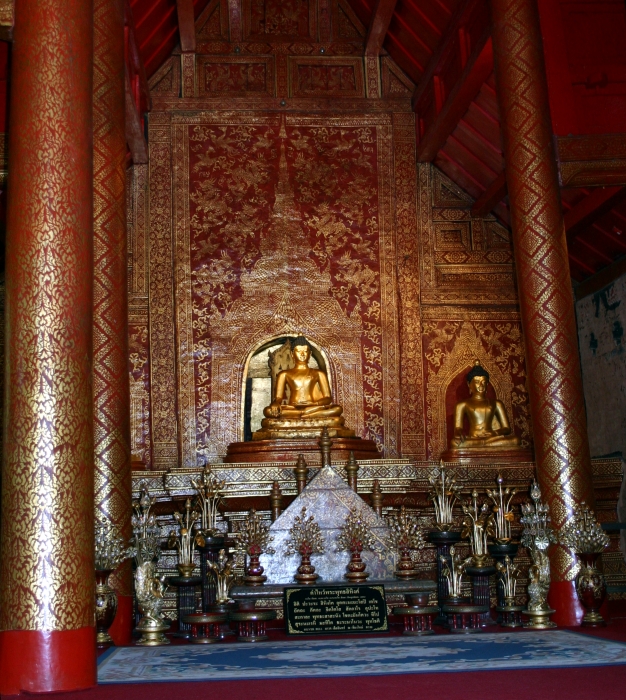
The interior of the viharn is at least equally beautiful as the exterior. The back wall of the viharn with the Phra Singh Buddha image sitting in the centre is covered with very detailed, intricate Lai Kham, which is red lacquer patterned with gold leaf.
The other three walls of the viharn are covered with mural paintings created during the 1820’s. Some of the murals show scenes of a popular local story, as well as scenes of daily 19th century life in Chiang Mai. Others depict scenes from the Jataka, the tales originating from India about the previous lives of the Buddha. The viharn Lai Kham was renovated in the early 19th century.
Viharn Lai Kham interior
Viharn Luang
The largest building in the wat is the Viharn Luang. The original viharn was built towards the end of the 14th century, but was replaced by the current building in 1925. This impressive viharn houses a very highly revered Buddha image named Phra Chao Thong Tip. This gold and copper image of a seated Buddha was cast in 1477.
Ubosot
The wooden ubosot was built in 1806. The ubosot or bot of the Wat Phra Singh is where monks get ordained.
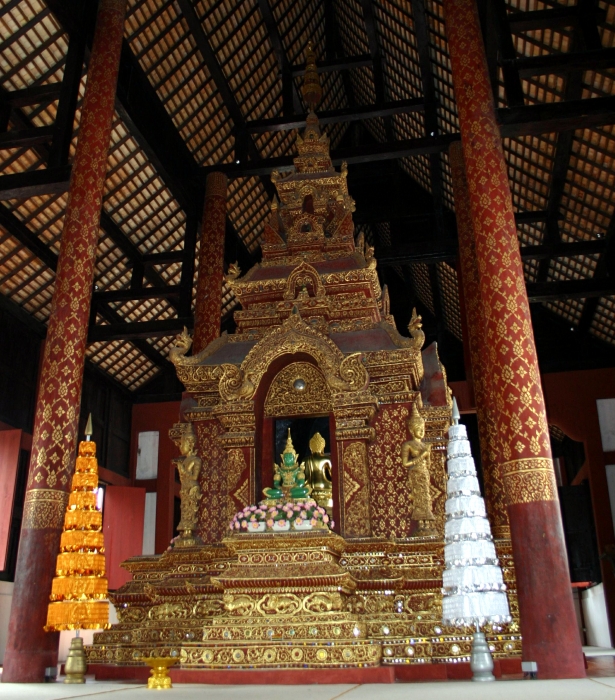
The gables of the bot are richly decorated with wood carvings. This building contains a very elaborate ku, a mondop like throne containing a Buddha image. The other end of the ubosot contains a copy of Thailand’s most revered Buddha image, the emerald Buddha. The original is housed in the Wat Phra Kaew in Bangkok.
Scripture library Ho Trai
The Ho Trai of the Wat Phra Singh is another excellent example of Lanna style architecture. The Ho Trai is the temple library, where ancient Buddhist scriptures are kept.
The library that was built towards the end of the 15th century is a very elaborate wooden structure built on a high stone base to protect the manuscripts from flooding and pests. The base is richly decorated with carvings of Devata figures, a sort of guardian angels. The wooden top structure is covered with glass mosaics and gilded lacquer works. The stairs leading to the Ho Trai are guarded by large mythical creatures.
The temple complex further contains several smaller chedis, the monks living quarters or kuti and a small building containing a reclining Buddha image. During the 1920’s the Wat Phra Singh was extensively renovated under supervision of the famous monk Khru Ba Srivichai, who was also involved in the renovation of other Chiang Mai temples.
How to get to the Wat Phra Singh
The Wat Phra Singh is located inside the old walled city centre of Chiang Mai. The main entrance is at the end of Ratchadamnoen road. Also in the old walled city and at walking distance are the Wat Chedi Luang and the Wat Chiang Man.
Entrance fee & opening hours
The temple complex is open daily from 6 am until 5 pm. Admission is free.
View Chiang Mai On-line Guide in a larger map
This temple contains supreme examples of Lanna art. A chedi was first built by King Pha Yu (r.1337-55) to house the bones of his father King Kam Fu (r.1328- 37). The original name of the temple was Wat Li Chiang Phra but this was changed to Wat Phra Singh when the Phra Sihing Buddha image was first housed there in 1367. The temple was almost certainly abandoned before Kawila re-established it by building the ubosot, and rebuilding the chedi. Chao Thammalangka (r.1813-21) and his successor, Chao Kham Fan (r. 1821-1825) further added (or rebuilt) the Viharn Lai Kham and the elegant scripture library building. Further renovations were carried out in the 1920's when Khru Ba Srivichai supervised the construction of the present main viharn and rebuilt the chedi. The ubosot and scripture library were renovated in 1929.
The recently restored Viharn Lai Kham is a classic example of a Lanna style viharn and was built to house the Phra Sihing image enthroned inside. Lai Kham refers to the elegant gold tracery used for decoration. The front of the building is in three tiers. The portico has finely carved gables as well as an ornate stucco sum above the main doors. On the inner walls of the Viharn Lai Kham are some murals originally commissioned by Chao Thammalangka. These are famous for their period style and the detail depicting earthy northern Thai scenes and the ways of the Burmese Court.
The murals show two fables. Prince Sang Thong of the Golden Conch lies on the north wall and the Heavenly Phoenix takes up the south. The fables illustrate the long suffering of heroes fighting against the powerful forces of evil before Indra intervenes and allows good to ultimately triumph.
Recent restoration has removed the earlier restoration of the 1920's to show clearly the original style of the work. Much of the detail has been lost, however.
The north wall shows work done by a Chinese artist whose likeness is found in a small picture at the top in the middle of the wall. Directly to the east of the main chedi, the wooden ubosot has ornate carvings around its doors and stucco patterns on the wooden pillars. The ubosot, which is usually locked, contains a tower-like shrine known as amondop. The shape of the shrine was said to be similar to an earlier structure that used to stand in Wat Phra Yeun, Lamphun.
The small scripture repository - ho trai - in the north-east corner is the finest of its type in the north. It sits atop a raised base decorated with stucco Devas. The upper wooden structure is decorated with carvings and stucco and is covered in glass mosaic and gilded lacquer.
At the back of the compound are the temple administration buildings, monks' kuti and a small hall contains a reclining Buddha.
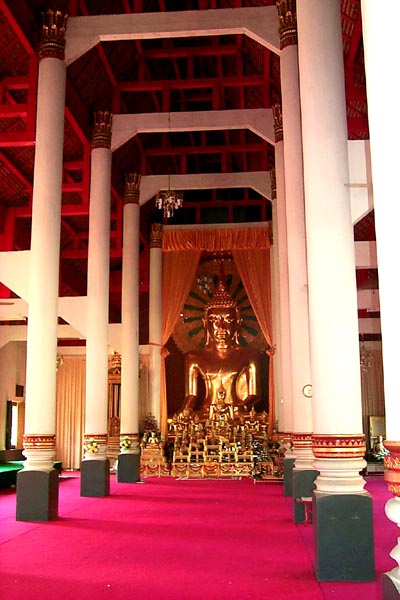
Within the walls of the ancient city are several old temples of interest. Among them, Wat Phra Singh is perhaps the largest and most interesting, although it may not seem so at first glance. Upon entering the main gate, you're greeted by a large and dusty parking area. Across the lot is a large wiharn (prayer hall) with an intricately carved front. This is your first clue that there's more here than there might appear.
The main prayer hall of Wat Phra Singh
The altar inside the large chapel is beautiful, though rather standard for Thai temples these days. We were somewhat amused by the plethora of "account books" strewn about on the right side of the altar (behind the columns in the picture we're afraid). In any temple that gets visitors, there is almost always a donation box with a guest book for you to write your name and amount donated in. Well, in this temple there were at least half a dozen boxes, each with a different purpose - maintenance of the temple building, electricity, taxes, etc. - and so each with its own account book. Upon making a donation to one or more purpose, you then have to scrabble around for the proper book to write it down in.
Plan of Wat Phra Singh, Chiang Mai
As you face the big wiharn, to your right is a small elaborate ho trai (library) built on a high stone base. The base has many beautiful carvings which have recently been renovated, as have the gilded carvings on the gable ends. Continuing on around the complex in a counter-clockwise direction, you'll find a drum tower set in a yard shaded by many old trees. Sometimes there's an artist or two at work here, and selling their work of course.
Elevated library with sculpted base
Directly behind the large prayer hall is a smaller building that serves as the temple's ordination hall (ubosot). This is where young monks are ordained and some other important religious events are held. The wooden building shelters a large brick and plaster altar, that I suspect pre-dates the outer building and was originally out in the open. The clues to this are the altar's shape and the fact that it sits in the middle of the building rather than at one end. The orientation of the entrances on a north - south axis rather than east - west is another clue. Like the library, the ubosot has recently been restored.
The chapel housing the Phra Singh Buddha image, next to the temple's main pagoda
Next to the ubosot, in a line with the wiharn, is a large whitewashed pagoda (chedi). Next to it is a small but very ornate Wiharn which is worth a closer look. The outside is decorated in gold and ocher in a style which is ornate but without the gaudiness of many other temples.
The decoration inside is also quite rich. There is a brocade-like gold and red pattern on parts of the roof and back wall behind the altar. On the altar here (and not on the altar of the main wiharn) sits the Phra Singh Buddha image from which the temple takes its name. "Phra" is Thai for a priest or cleric and also used to refer to Buddha images. "Singh" means lion, but may be a corruption of the Thai word for Sri Lanka, where the image is supposed to come from.
Wat Phra Singh was founded in the fourteenth century to enshrine the ashes of King Kam Fu.
From Wat Phra Singh, you might want to go on to Wat Chedi Luang, which is just a short walk away. Another important temple within the walls is the oldest: Wat Chieng Man. It's another short walk away, near the Chang Puak gate and the Thai Airways ticket office.
You can take it with you.
Wish you could have this information with you when you visit Chiang Mai? Now you can. Check out our ebook guides.
Getting There
The temple is located at the end of Ratchadamnoen Road which nearly bisects the old city, running from the Tapae gate all the way to the temple, which is just inside of the Suan Dok gate.


 The temple was almost certainly abandoned before Kawila re-established it by building the ubosot, and rebuilding the chedi. Chao Thammalangka (r.1813-21) and his successor, Chao Kham Fan (r. 1821-1825) further added (or rebuilt) the Viharn Lai Kham and the elegant scripture library building. Further renovations were carried out in the 1920's when
  On the inner walls of the Viharn Lai Kham are some murals originally commissioned by Chao Thammalangka. These are famous for their period style and the detail depicting earthy northern Thai scenes and the ways of the Burmese Court.
 Directly to the east of the main chedi, the wooden ubosot has ornate carvings around its doors and stucco patterns on the wooden pillars. The ubosot, which is usually locked, contains a tower-like shrine known as amondop. The shape of the shrine was said to be similar to an earlier structure that used to stand in Wat Phra Yeun, Lamphun.